980 Detained as France's Second Protest Wave Turns Violent
Interior Minister Laurent Nuñez announced the figure as tear gas and water cannon were deployed in Paris, Marseille, and Bordeaux following daytime marches.
By Lucy Lefebvre ·
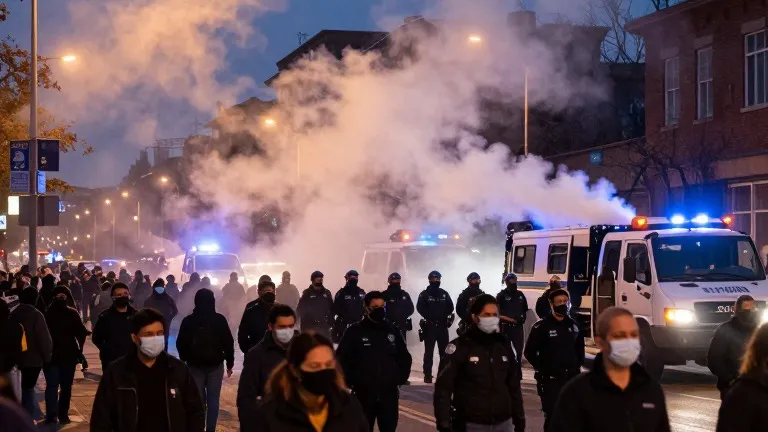
Interior Minister Laurent Nuñez confirmed on Saturday that nearly 1,000 people were detained in France during a new round of nationwide protests. The official estimate placed the number at 980 arrests, with authorities noting the count would likely increase as processing continued through the night.
The demonstrations began largely peacefully during the day before descending into clashes in multiple cities in the evening. Police deployed tear gas and water cannon to disperse crowds in Paris, Marseille, and Bordeaux. In Marseille, protesters set barricades on fire, while in Bordeaux, demonstrators tore wooden boards from a shop front.
The interior ministry estimated the turnout at 410,000 participants. Trade unions disputed this figure, claiming approximately 800,000 people joined the marches. To prevent a repeat of the severe disorder from the previous weekend, authorities deployed 70,000 police officers and imposed movement restrictions in several urban centers.
In Paris, tensions escalated at the end of a march from Porte d'Italie toward Porte de Vincennes. Police utilized an elite unit typically reserved for organized crime and counter-terrorism operations. Protesters constructed makeshift barricades and threw objects at officers. Police responded with baton charges against groups of masked youths who were breaking windows at a car dealership.
Nuñez stated that several thousand radical activists had gathered at the rear of the march. He identified around 500 individuals as known rioters. The minister reported two serious injuries, one in Toulouse and the other in Clermont-Ferrand. In Lyon, police fired tear gas into a crowd that had assembled in an area declared off-limits by the local prefecture.
A protester in Lyon, identified as a student, told reporters that the group consisted of about 150 secondary school and university students. The protester noted that visibility in the street was extremely low due to the gas. In Paris, a 26-year-old demonstrator named Zelie described the situation as causing widespread suffering, stating that it had become too much for many families.
Two masked teenagers in Paris expressed feelings of abandonment by the government. One of the teens acknowledged that looting was not ideal but cited poverty and police violence as driving factors. The teen predicted the protests would continue until government demands were met.
President Emmanuel Macron had issued a decree earlier in the week limiting permitted demonstrations to those organized by recognized trade unions. This restriction followed the previous weekend's unrest, where officers were outnumbered and hundreds of businesses were looted. Fast-track court hearings in recent days have resulted in hundreds of jail sentences for vandalism, arson, and looting.
The unrest extended beyond French borders. Riot police in Tirana, Albania, fired tear gas at thousands of anti-government demonstrators. Clashes were also reported in Brussels. In Milan, hundreds of soldiers and police blocked gathering spots to prevent a recurrence of the violence seen in the prior week.
The previous weekend saw approximately 550,000 people march against rising fuel prices and the cost of living. That event resulted in more than 2,500 arrests and over 2,000 affected businesses. Chambers of Commerce and Industry estimated the damage at hundreds of millions of euros. About 1,000 police officers were injured, including one demonstrator who lost a hand to a crowd-control grenade. With presidential elections six months away, leading candidates have begun blaming Macron and his cabinet for the instability.
Source: BBC News