Moon water reserves cap sustainable settlements at 10,000 residents
Harvard and Durham researchers calculate that lunar ice supplies would sustain a million-person city for only a century, but support a much smaller town for centuries.
By Noor Rossi ·
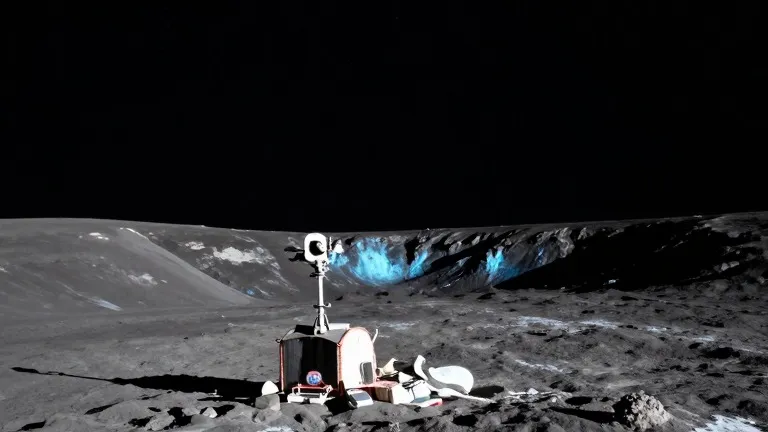
Residents of future lunar settlements may face hard limits on their numbers. A new study published in Frontiers in Space Technologies calculates that the moon's available water can sustain a population of 10,000 people for centuries. For a city of one million, the supply would last approximately 100 years.
The research responds to recent claims by major space industry leaders. In February, SpaceX CEO Elon Musk stated the company is building a self-growing city on the moon, a project he estimates could be completed in under 10 years. Blue Origin CEO Jeff Bezos has predicted that millions of people will live in space by 2045. Martin Elvis of Harvard University's Smithsonian Astrophysical Observatory and Jonathan McDowell of the Durham University Space Research Centre tested these ambitions against physical constraints.
Power is not the limiting factor. The authors found that solar and nuclear energy sources can easily support one million inhabitants. Water, however, presents a tighter constraint. Most lunar water resides in permanently shadowed polar regions. Current estimates suggest a total reserve of roughly one billion tonnes. If a million people recycled 98 percent of their water, the same rate achieved on the International Space Station, that reserve would deplete in a century.
Elvis described the total volume as modest. He compared it to a small lake, noting that such a source cannot supply a large city for a long period. A settlement of 10,000 people, by contrast, would remain sustainable for centuries under the same recycling assumptions. McDowell noted that covering the moon with large cities requires transporting water to the surface, as it is not currently accessible in usable form.
The study's assumptions may be optimistic. Elvis suggested the one-billion-tonne estimate is likely 20 to 30 times too high. He estimates that only 1 percent of that figure is reliably recoverable, which would reduce the lifespan of a million-person city from 100 years to just one year. Gordon Osinski, a planetary geology professor at Western University, added that the physical form of the water remains uncertain. Satellite data has uncertainties, and the ice may be trapped in soil like Arctic permafrost, making extraction difficult.
The researchers emphasized that the findings are not discouraging. McDowell stated that the truth is never negative, and that negative outcomes only occur when people attempt projects that are destined to fail. The study provides a baseline for engineering decisions rather than a final verdict on lunar habitation.
Source: CBC News