Sanctioned Tankers Detour Around Arctic Choke Point After Ice Delays
Vilkitsky Strait ice forced shadow fleet vessels to wait up to two weeks for icebreakers before rerouting, complicating Moscow's plans to expand cargo volumes along the Northern Sea Route to 66 million tons by 2030.
By Noor Rossi ·
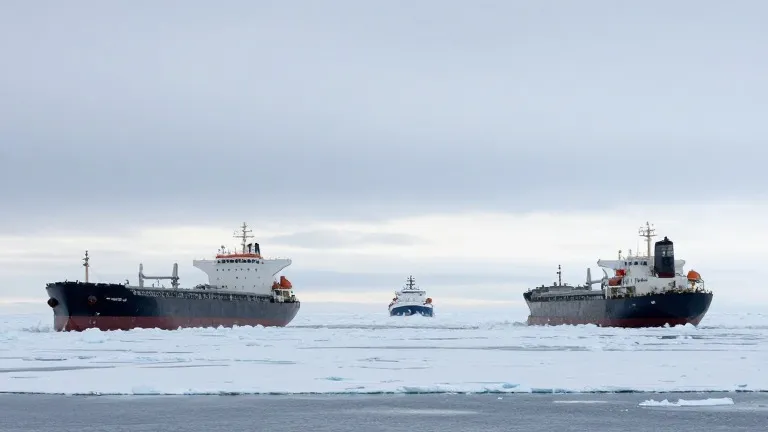
Several Russian tankers subject to Western sanctions anchored in the Vilkitsky Strait in July after ice blocked their path, forcing them to wait for help and, in most cases, abandon the route. The strait is a 55-kilometer-wide channel between the northern Siberian coast and Bolshevik Island. Two nuclear-powered icebreakers, which were days away, were dispatched to assist. One tanker eventually cleared the passage; the others waited as long as 14 days for the icebreakers, still could not pass, and took a different route.
Traffic volumes on the Northern Sea Route remain far below the targets Moscow has set for it. President Vladimir Putin said 37 million tons of cargo moved along the route, without traversing its full length, in 2025, and projected that figure would almost double by 2030. Kremlin officials were working toward 80 million tons by 2024 as of 2019. The Center for High North Logistics, funded by Norway, reported that Russia had shipped about 2 million tons of mostly crude oil, roughly 15 million barrels, by the end of September. Reuters, citing traders and shipping data, put the total at about 20 million barrels by mid-October, a 50 percent rise from 2025 and about 1 percent of Russia's seaborne oil exports.
Ksenia Vakhrusheva, who heads the Arctic project at the Lithuania-based environmental group Bellona, said the July episode shows that "less ice doesn't mean easier navigation." Melting ice can break apart and pack into narrow straits, she said, blocking ships that lack an ice class designation. Putin has called the route "a reliable and safe path to the world's largest markets," remarks he made last month at the launch of the Vostok Oil project on the Taimyr Peninsula.
Tomas Alexa, a senior analyst at the maritime security consultancy Ambrey, attributed part of the difficulty to sanctions, which he said limit Russia's capacity to build and service Arctic-capable vessels. Spare parts and construction materials must pass through third parties, he said, and repair work once handled by Norwegian, Danish and Dutch firms is no longer available. He described the shipping volumes as a surge "from a relatively low base."
Other nations are testing the route. South Korea reported on October 22 that its first container ship had used the Northern Sea Route, and officials there noted large ice floes in the Bering and Vilkitsky straits. China operated a scheduled container service to Europe along the route this year for the first time and completed several voyages. Catherine Sendak of the Center for European Policy Analysis said questions remain over tolls and services Moscow might offer commercial vessels, and she said she did not think good answers exist yet.
Security and environmental concerns are rising alongside the traffic. Kaja Kallas, the EU foreign affairs chief, said on October 21 while outlining a new EU Arctic strategy that the region "has become a front line of global power competition." NATO began its Arctic Sentry mission in February, and the United States announced plans last month to expand its military presence in Greenland. Vakhrusheva said oil degrades more slowly in cold conditions and can spread over ice, and she noted that Russia publishes no information on incidents along the route.
Source: RFE/RL