Three Halley meteors recorded over Toccoa
Tim McCollum photographed three Orionid meteors from Comet 1P/Halley debris between 3 a.m. and 4 a.m. on Oct. 21, ahead of the shower's peak activity.
By Noor Rossi ·
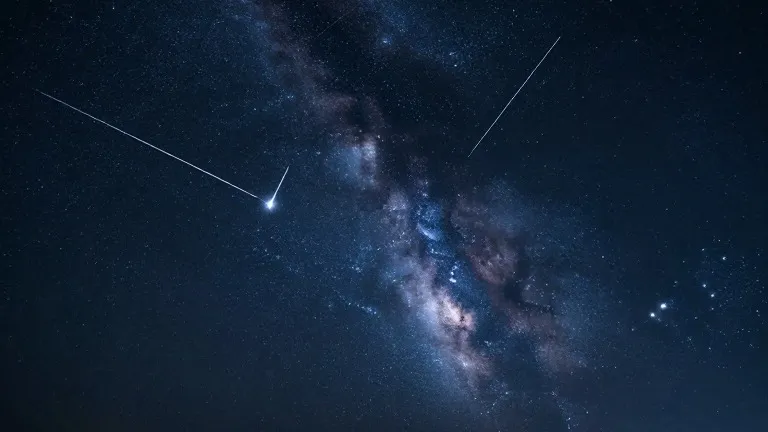
A Georgia photographer captured three bright meteors from Halley's Comet debris in a single composite image.
Tim McCollum recorded the events above Toccoa, Georgia, between 3 a.m. and 4 a.m. on Oct. 21. The meteors belong to the Orionid shower, which is fueled by particles shed from Comet 1P/Halley. The comet itself remains more than 3 billion miles from Earth, but its leftover debris continues to burn up in the atmosphere as glowing trails.
McCollum used a Canon EOS Ra camera paired with an RF 28-70 f2.0 lens to collect the data. He took multiple 30-second exposures while a star tracker kept the equipment locked on the shower's radiant point. That point is located near Betelgeuse, a red giant star in the constellation Orion. Each meteor in the final image appears to radiate outward from that specific area of the sky. The individual frames were merged into a single file using PixInsight software.
The photograph includes several deep sky objects alongside the meteor trails. Orion's Belt and the Orion Nebula appear on the right side of the frame. The Rosette Nebula, designated as Caldwell 49, is also visible within the dense starfield. These objects sit against the diagonal band of the Milky Way's galactic plane, which cuts across the image. Numerous star clusters are also present in the background starfield.
The Orionid meteor shower will remain active until Nov. 7, providing additional nights for observers to view the display. The shower peaks in activity later in October. Skywatchers may also witness the Taurid meteor shower, which is produced by debris from Comet 2P/Encke. This stream sometimes produces large fireballs known as Halloween Fireballs. McCollum's image was taken as the annual display built toward its peak, offering a documented example of the shower's activity before the maximum rate was reached.
Source: Space.com