Alcis data: Afghan ban fuels poppy surge in Pakistan and Iran
Afghan farmers are leasing land in Pakistan and Iran, shifting opium production across borders as the Taliban's narcotics ban takes hold.
By Noor Rossi ·
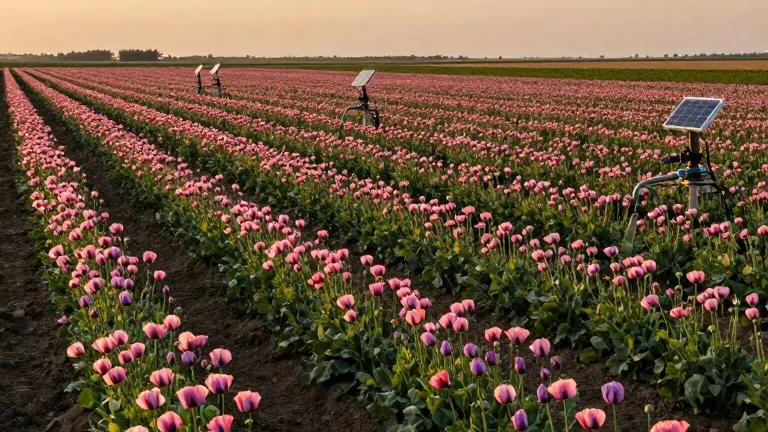
Satellite imagery from the British firm Alcis identified more than 9,000 hectares of poppy cultivation in Balochistan, the southwestern province of Pakistan. The data, combined with interviews from local growers, indicates that opium production is expanding rapidly in border regions of Pakistan and Iran following a 2022 ban by the Taliban in Afghanistan.
David Mansfield, a UK-based expert on illicit drugs, stated that the Taliban ban and instability in the tri-border area have created conditions for widespread cultivation. He described the remote borderlands of Afghanistan, Pakistan, and Iran as a global center for opium production. Mansfield, author of a report for Alcis released in August, noted that most of the detected crops are concentrated in the districts of Loralai and Killa Abdullah.
Afghan farmers from Kandahar and Helmand provinces are leasing land in Pakistan, bringing capital and agricultural expertise. Lala Jan Kakar, a resident of Killa Abdullah, explained that these growers invest millions of Pakistani rupees in solar-powered wells and share profits with local landowners. Poppies are harvested twice annually, and many farmers doubled their cultivated acreage in 2026. Mansfield characterized this expansion as a stark indication that cultivation levels will rise further in 2027.
In Iran, a similar pattern is emerging in Sistan-Baluchistan, a province that borders Afghanistan. Afghan farmers work as tenants and sharecroppers, leveraging family ties to secure land. Satellite images from 2026 show extensive fields in the region, some equipped with drip irrigation. This costly infrastructure suggests growers planted in late 2025 with an expectation that eradication efforts would be limited. Iranian authorities have been unable or unwilling to destroy the current crop while focused on conflicts with the United States and Israel.
Pakistan's Interior Ministry and the provincial government did not respond to requests for comment, though Islamabad has denied reports of widespread cultivation. The United Nations Office on Drugs and Crime acknowledged spillover effects, noting that scarce data and sharp rises in eradication figures point to a shift in production. Abdul Qahar Wadan, a former National Assembly member, claimed that senior military officials and political figures support the crops in exchange for commissions. Monawar Hussain, the chief administrative officer of Killa Abdullah, rejected this claim, citing a decline in cultivation after an eradication campaign last year.
Local residents report that insecurity, drought, and flash floods have devastated traditional fruit farming. One farmer in Killa Abdullah, speaking anonymously, alleged that growers pay bribes to local authorities through intermediaries. He said that when media attention increases, growers sometimes plant poppies on barren land so officials can destroy the crop and publicize the effort. The demand for poppies, according to Kakar, now exceeds that for fruit in both volume and income.
Source: RFE/RL