Kinney and Austin race for safe seats in polarized districts
Two candidates running against the tide describe the financial strain and logistical hurdles of challenging long-term incumbents in one-party states.
By Isabel Moretti ·

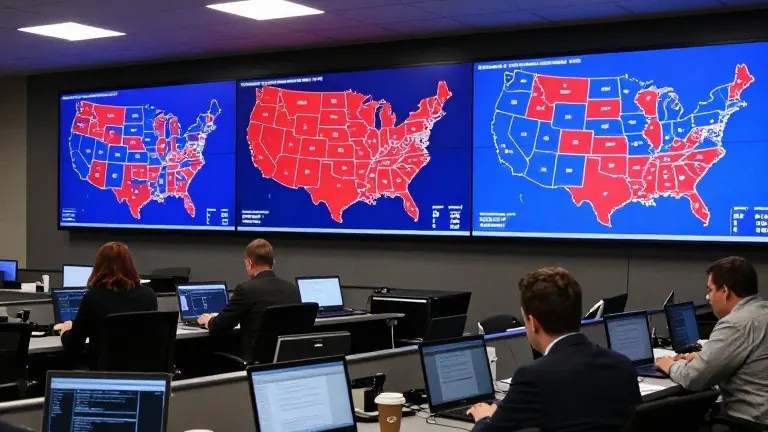
Eighty percent of congressional races this cycle are rated solidly for one party, leaving candidates like Lisa Kinney and George Austin to fight uphill battles with limited resources. Kinney, a Democrat, is running for the single House seat in Wyoming, a district that has elected only Republicans since the late 1970s. Austin, a Republican, is challenging the Democratic incumbent in Connecticut's second congressional district, a seat held by Rep. Joe Courtney for two decades.
The trend of monolithic partisan control has reached a high point. Eric Ostermeier, founder of Smart Politics, noted that 19 state delegations currently consist entirely of members from a single party. He stated that this number marks the highest level seen in nearly three-quarters of a century, with 1953 being the last time such figures were recorded.
Kinney began her campaign in Casper, Wyoming, where she held court at a diner to meet voters. She faced skepticism from locals who cited the state's red lean and the influence of the national party brand. One voter, Joe Beck, told her he had already voted for her but warned of an incoming tsunami on the first Tuesday in November. Kinney, a former state senator, operates without a dedicated campaign office, relying on a small group of helpers and long drives to spread her message on public lands and health care costs.
Her husband, Rodney Lang, framed their effort as a way to strengthen the party structure even in the face of a potential loss. Kinney described herself as a realist who knows many voters will choose the candidate with an R next to their name, yet she maintains that she can win.
Austin, a home builder and former football coach, faces similar odds in Connecticut, where Democrats have won 45 straight U.S. House elections since 2008. He has invested a quarter of a million of his own money into the campaign and serves as his own scheduler and volunteer coordinator. He noted that 46 of the state legislature's 187 seats are uncontested, a statistic he cites as a motivator to restore balance in representation.
Both candidates point to gerrymandering and geographic sorting as drivers of these safe seats. Ostermeier explained that it is difficult for state-level candidates to distance themselves from the national party identity. Austin said he often loses the chance to discuss policy specifics when voters learn he is a Republican or when President Trump enters the conversation.
The next major step for both campaigns is the general election on the first Tuesday in November. Kinney continues to tour the state to meet voters, while Austin focuses on issues like congressional gridlock and term limits to find common ground.
Source: KWMU