House Fight Narrows to 46 Battleground Districts and New Maps in Seven States
Democrats need a net gain of three seats to retake the House, a margin that hinges on the performance of 46 competitive districts and the voting patterns in newly drawn congressional boundaries.
By Lucy Lefebvre ·
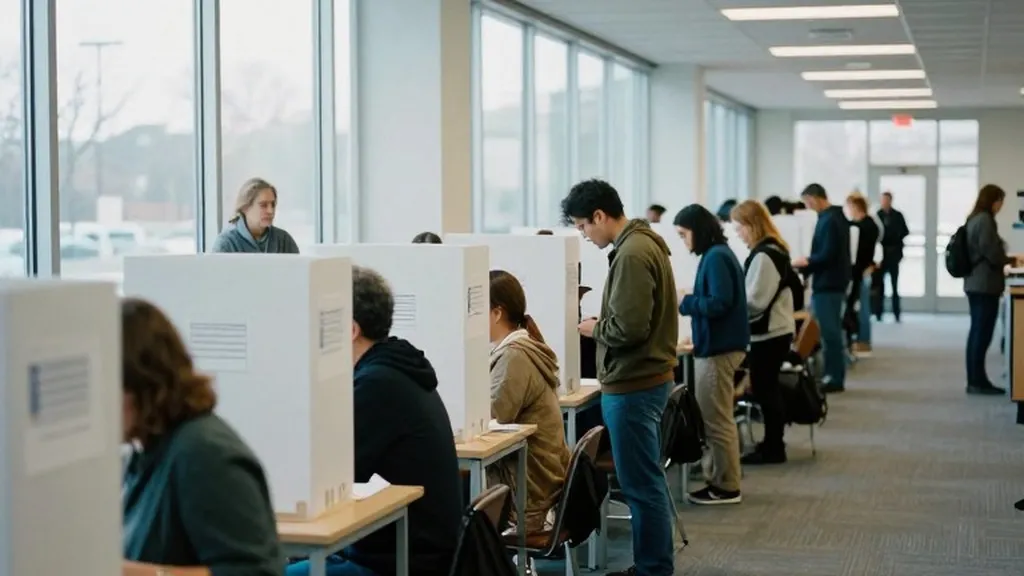
All 435 seats in the U.S. House are up for election today, with the outcome hinging on a razor thin margin that defines the balance of power in the lower chamber. Republicans currently hold 218 seats, Democrats hold 214, and one seat is held by an independent, with a few vacancies remaining. For Democrats to secure a majority, they must achieve a net gain of exactly three districts. This means Republicans can lose no more than two seats and still retain control of the chamber. The Associated Press notes that one or two seats could tip the balance, making the race for these specific districts the central focus of the day's voting.
Ballotpedia identifies 46 battleground districts where the outcome is uncertain and where the majority will likely be decided. These districts are split between 25 currently held by Democrats and 21 held by Republicans. The competitiveness of these areas is driven by shifting political landscapes and the specific demographics of the districts. Voters in these 46 districts are deciding not just local representation but the overall legislative agenda for the final two years of President Donald Trump's second term. The stakes are high because the House controls the power of the purse and the ability to launch investigations.
A significant portion of this fight takes place in districts that voted for the opposing party's presidential candidate in 2024. Twenty-one Democratic held districts cast more votes for Trump than for Kamala Harris in the previous presidential election. Conversely, nine Republican held districts voted for Harris. This data suggests that the partisan alignment in these areas is fluid and that voters may be separating their local House choices from their national presidential preferences. The Associated Press describes the election as a referendum on the administration, with voters struggling with high prices and anger over the war with Iran. These economic and foreign policy concerns are likely to influence the decisions in these swing districts.
The structure of the race is further complicated by the fact that 60 House incumbents are not running for re election. This group includes 23 Democrats and 37 Republicans, creating a substantial number of open seats that do not carry the name recognition of established politicians. These open seats are often more vulnerable to change because they lack the institutional advantage of an incumbent. The absence of these 60 officials forces voters to engage more deeply with the candidates on the ballot. This dynamic adds to the unpredictability of the 46 battleground districts, as many of these races feature new faces competing for the attention of undecided voters.
The voting patterns are also being influenced by new congressional maps in seven states. California, Florida, Missouri, North Carolina, Tennessee, and Texas are using new maps resulting from mid decade redistricting, and Ohio is also utilizing a new map. These changes in district boundaries can alter the partisan composition of the electorate in specific areas. Republicans attempted to beat the traditional midterm pattern, where a president's party almost always loses seats, by redrawing these lines. However, the Associated Press notes that new districts in Florida and elsewhere may not vote exactly as drawn. The effectiveness of these new maps will be tested as votes are counted in these seven states.
Money plays a critical role in these 46 races, with the 2026 elections expected to be the most expensive in history. Republican committees have outraised and outspent their Democratic counterparts, aided by Trump affiliated groups and Elon Musk. According to AP analysis of AdImpact data, 88.1% of Republican general election TV ad spending went to states and districts that Trump won in 2024. This includes more than 850 million dollars spent in areas where he won by 10 points or more. This financial edge is an obstacle for Democrats, who must compete against heavy advertising in districts that are already leaning Republican. The disparity in spending highlights the challenge Democrats face in turning the tide in the House.
Despite the financial disadvantage at the committee level, Democrats outraised their opponents at the candidate level. This suggests that individual campaigns are managing to secure significant funds even if the party's overall fundraising is lower. The Democratic Congressional Campaign Committee chair, Rep. Suzan DelBene, stated that the American people are angry and want change. This sentiment is echoed by voters like James Moore, a librarian in Raleigh, North Carolina, who cited higher taxes and healthcare costs as reasons for his vote. These personal economic narratives are central to the Democratic message in the 46 battleground districts, contrasting with the Republican emphasis on stability and the president's performance.
The mood among Democrats is described as cautiously optimistic, while Republicans are bracing for the possibility of losing the House. The Associated Press reports that Republicans are fighting to hold the Senate, but the House race is the primary battleground for the three seat margin. The new maps and the large number of open seats create a volatile environment where small shifts in turnout can determine the outcome. Voters are focused on issues such as the cost of living and oversight of the administration, which are key themes for the Democratic party. The ability to mobilize voters in these 46 districts will be the deciding factor in whether Democrats can achieve the necessary net gain of three seats.
The administration's actions have also impacted the race, with the Justice Department threatening to prosecute local election officials. This has raised fears of interference and intimidation among Democrats. A federal judge temporarily barred the administration from carrying out a plan to prevent noncitizen voting, a move that critics say risks disenfranchising eligible voters. These legal battles add a layer of complexity to the election day process. The U.S. Postal Service has added hours and staff to ensure mail ballots are counted on time, reflecting the high volume of early voting. More than 57 million people had already voted as of Monday, surpassing the early vote of four years ago in many states.