Senate Math: Democrats Need Four Seats to Retain Oversight Power in 2027
With polls open in thirteen key states, the path to Senate control hinges on flipping Republican seats in Maine, Kansas, and Michigan.
By Lucy Lefebvre ·
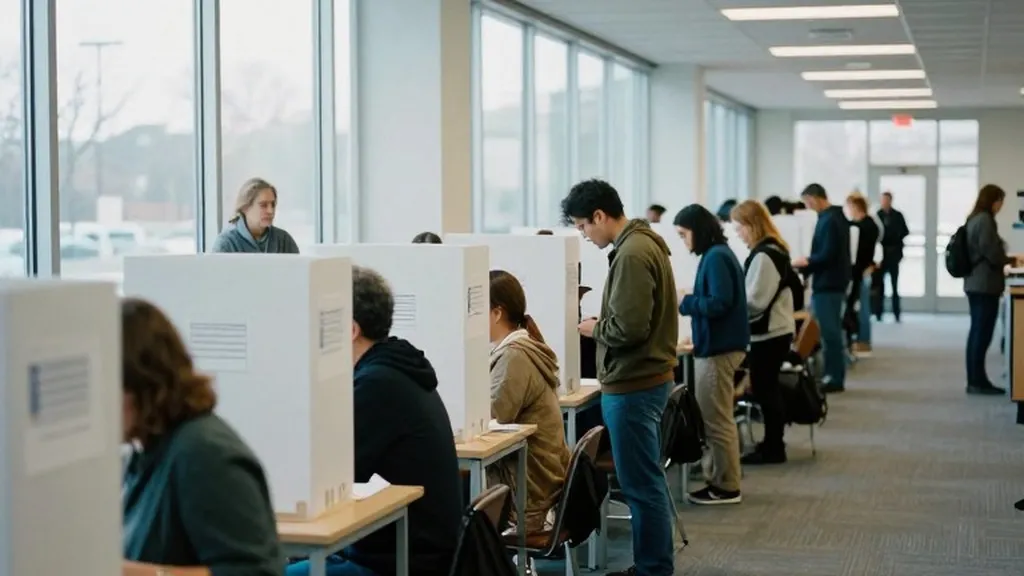
Election Day in 2026 has arrived with the fate of the United States Senate hanging in the balance. Voters across the country are casting ballots to determine which party will hold the gavel for the final two years of President Donald Trump's second term. The Associated Press describes this midterm election as a referendum on the administration, with many citizens expressing frustration over high prices and an unpopular war with Iran. The outcome will dictate the balance of power in the upper chamber, where Democrats currently hold 45 seats and Republicans hold 53, plus two independents who caucus with the Democrats.
According to Ballotpedia, 35 of the 100 Senate seats are up for grabs this year. This includes 33 regular elections and two special elections for the remainder of terms held by Marco Rubio in Florida and JD Vance in Ohio. Republicans currently hold 20 of these seats, while Democrats hold 13. To achieve a majority, Democrats must secure a net gain of four seats. Conversely, Republicans can afford to lose only two seats and still maintain control of the chamber. The winners will begin their six-year terms on January 3, 2027.
The path to victory for both parties is fraught with difficulty. Republicans are bracing for the possibility of losing the House and are fighting hard to keep the Senate. The Associated Press notes that one or two seats could tip the balance of either chamber. Democrats, meanwhile, are described as cautiously optimistic. However, they face significant obstacles, including a substantial Republican advantage in funding and the effects of mid-decade redistricting in states like California, Florida, and Texas. These new maps have altered the political landscape, and it remains to be seen how voters will respond to the changed districts.
Thirteen Senate races are currently considered battlegrounds, and their outcomes will largely determine the final tally. In Maine, Senator Susan Collins is facing a challenge from former state Senate President Troy Jackson. The Associated Press notes that economic strain and tariffs have made this traditionally Republican state competitive. Maine is currently rated as a toss-up by all four major tracking services. In Michigan, the seat is open after Gary Peters retired, and the race pits Republican former Representative Mike Rogers against Democrat Abdul El-Sayed. This contest is also seen as a toss-up or lean Democratic by various analysts.
Kansas has emerged as a central theater in the fight for Senate control. Although the state is reliably Republican, the race between incumbent Roger Marshall and his Democratic opponent has drawn significant attention. Tracking services rate the race as a toss-up to lean Republican. In Georgia, Senator Jon Ossoff is defending his seat against Republican Representative Mike Collins. The state voted for Kamala Harris in 2024 by a margin of 2.2 percent, and the race is currently leaning to likely Democratic. These three states are critical because they offer the best opportunities for Democrats to reach their target of a net four-seat gain.
Other key matchups include North Carolina, where Democratic former Governor Roy Cooper faces former RNC chair Michael Whatley. The Associated Press highlights this race as pivotal, especially after incumbent Thom Tillis retired following a clash with the president. In Ohio, Democratic former Senator Sherrod Brown is challenging Republican Senator Jon Husted. In Texas, Republican Attorney General Ken Paxton, who received the president's backing over incumbent John Cornyn, faces Democrat James Talarico. The president's influence is evident in these races, as he has held dozens of rallies to support his candidates, ending his schedule Sunday in Salina, Kansas, where he urged voters to pretend he was on the ballot.
Financial disparities are a defining feature of this election cycle. The 2026 elections are likely to be the most expensive in history. Republican committees have outraised and outspent their Democratic counterparts, aided by Trump-affiliated groups and Elon Musk. An analysis by the Associated Press of AdImpact data shows that 88.1 percent of Republican general election TV ad spending went to states and districts that Trump won in 2024. This includes more than $850 million spent in areas where he won by ten points or more. Despite this committee-level advantage, Democrats have outraised their opponents at the candidate level, suggesting a different dynamic in local campaigning.
Voters are heading to the polls with strong feelings about the state of the nation. AP-NORC polling indicates that 35 percent of U.S. adults approve of Trump's job performance, while only 25 percent approve of his handling of the economy. About seven in ten Americans say the country is heading in the wrong direction. Mark Barker of Palm Beach Gardens, Florida, told reporters that he has been following the president's lead and believes he is doing an awesome job. In contrast, James Moore, a librarian in Raleigh, North Carolina, cited higher taxes and healthcare costs as his primary concerns. These voices reflect the broader divide that will shape the results.
The administration has also been involved in several legal battles over election administration. A federal judge temporarily barred the Trump administration from carrying out a plan to prevent noncitizen voting, a move critics argued risked disenfranchising eligible voters. The administration also sued in Alaska and California regarding ballot handling and certification. In Alaska, a lawsuit was filed related to the certification of the Senate result, adding a layer of legal complexity to the day's proceedings. The U.S. Postal Service has added extra staff and hours to ensure mail ballots are counted on time, a crucial step given the high volume of early voting.