Seven tight Senate races and ranked voting could stretch election night results into weeks
While House outcomes may settle quickly due to wider margins, Senate control hinges on seven close states and two using ranked choice voting, potentially delaying final counts for days.
By Isabel Moretti ·
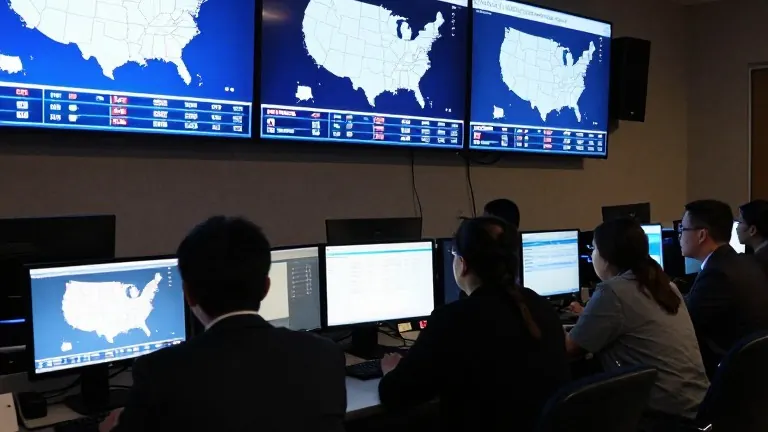
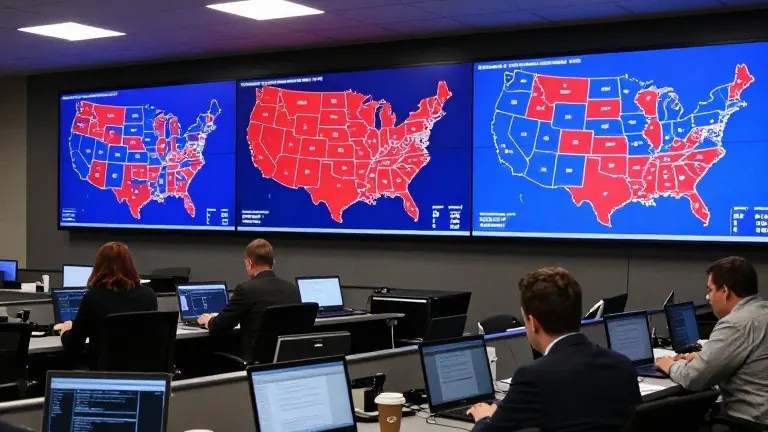
Seven states currently feature highly competitive Senate races that could determine chamber control, with voting in two of those states using ranked choice voting to further extend the counting process. This setup creates a distinct risk that Senate results will remain uncertain for days or even weeks, even as House outcomes appear likely to solidify sooner due to larger vote margins in most districts.
Polls close in stages across the country beginning at 7 p.m. Eastern Time on Tuesday. The first batch includes Georgia, Indiana, Kentucky, South Carolina, Virginia, and Vermont. In Georgia, Democratic Senator Jon Ossoff holds a projected advantage over Republican Representative Mike Collins. However, the gubernatorial contest between Republican Rick Jackson and Democratic Keisha Lance Bottoms remains tight. Georgia Secretary of State Brad Raffensperger stated that new laws require counties to report results within one hour of polls closing, a change from previous delays.
South Carolina presents another tight Senate race between Republican Senator Darline Graham, who was appointed following her brother Lindsey Graham's death, and Democratic nominee Annie Andrews. National polls describe the contest as a toss-up in a heavily Republican state, while the Cook Political Report gives Republicans the advantage.
At 7:30 p.m. Eastern Time, polls close in North Carolina, Ohio, and West Virginia. North Carolina's Senate race between former Democratic Governor Roy Cooper and former Republican National Committee Chairman Michael Whatley is viewed as the most likely Democratic flip. Ohio features a deadlocked Senate race between Republican Senator Jon Husted and former Democratic Senator Sherrod Brown. In the Ohio governor's race, Democratic candidate Amy Acton leads Republican Vivek Ramaswamy, whose recent attack ad featuring Acton's estranged mother has generated significant backlash.
By 8 p.m. Eastern Time, polls close in more than half the country, including Florida, Pennsylvania, and Maine. In Florida, Republican Representative Byron Donalds holds a slight poll advantage in the governor's race against Democrat David Jolly. The state's redrawn congressional maps make seven House seats competitive, with two classified as toss-ups by the Cook Political Report. Pennsylvania's three former toss-up House seats now lean toward Democrats.
Major poll closures occur at 9 p.m. Eastern Time in states including Iowa, Kansas, Michigan, and Texas. These states contain four of the seven critical Senate races. In Texas, Democrat James Talarico faces Republican Ken Paxton, with early voting data potentially giving Talarico an initial lead. In Michigan, the governor's race between Abdul El-Sayed and Mike Rogers remains a toss-up, with the outcome hinging on voter response to recent advertising campaigns.
The final batch of polls closes at 11 p.m. Eastern Time in California, Idaho, Oregon, and Washington. California's newly redrawn congressional maps, approved by voters in 2025, have shifted several close House races toward Democrats. The counting process in these states will determine the final composition of the House and provide early signals on the competitive Senate races.
Source: WWNO