Trump’s Approval Plunge Sets Stage for Historic Midterm Losses
Polls show the president's support at 37%, a level historically tied to major shifts in congressional power, while experts warn of deepening distrust in election processes.
By Noor Rossi ·

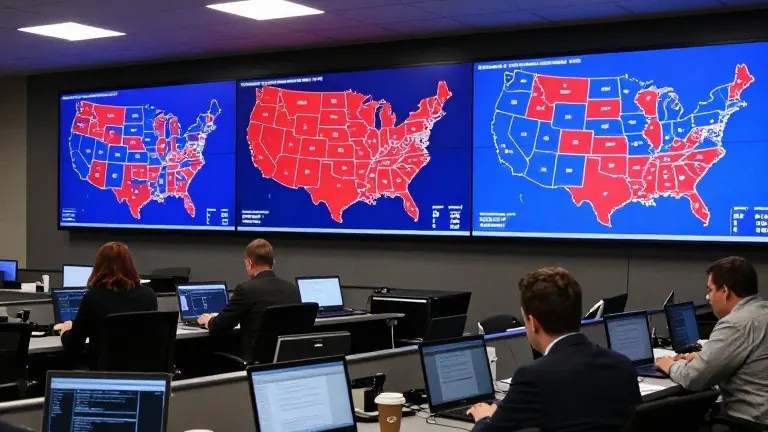
President Trump’s approval rating has fallen to an average of 37%, a figure that historically predicts severe midterm losses for the White House party. This drop from 52% in early 2025 places the administration in a historically vulnerable position for Tuesday’s elections.
Polling data indicates the midterm pendulum is swinging against the incumbent party, consistent with trends seen in nearly every election over the last century. Republicans face potential losses not only in blue states but also in swing states and deep red states where Trump previously won by double-digit margins. The president spent the final weekend of the campaign in Iowa and Kansas, visiting regions he carried in 2016, 2020, and 2024 to protect the Senate majority. Iowa voted for Barack Obama in 2008 and 2012, while Kansas has not sent a Democrat to the Senate since 1932.
Observers predict the Republican Party will lose its slim majority in the House. The Senate outcome remains uncertain, with the possibility of a tie broken by Vice President Vance. Trump’s strategy focuses on limiting losses by personalizing the race, a tactic that contrasts with his first term. Critics argue his high visibility makes him a target, with rallies using the slogan "No Kings" to oppose his leadership style. Economic frustrations, particularly over gas prices and inflation, drive much of the voter dissatisfaction despite his promises of lower costs.
Democrats face internal challenges even if they gain power. A potential House majority would be modest, and a narrow Senate win would empower independent members. Ruy Teixeira, a political demographer now at the American Enterprise Institute, outlined 11 questions for the party in October. His final query asks whether Democrats will prioritize working-class interests over issues like race, gender, and social policy. The party has united around opposition to data centers for the AI industry and the war on Iran, but divisions between consensus builders and left-leaning firebrands remain evident in the candidate slate.
The 2026 elections also test public faith in the voting system itself. Since the Help America Vote Act of 2002, states have replaced punch-card ballots with touch-screen technology and paper trails. Nonpartisan experts generally defend the current administrative standards. However, Trump has repeatedly questioned the integrity of the process, a stance he has maintained since 2016. He dismissed the 2020 results, leading to the January 6, 2021, protest, and he continues to label unfavorable information as fake. This history creates tension for election night and the weeks following, as voters and officials prepare to certify results under scrutiny.
The next step is the November 3 election, where millions of Americans will vote. The results will determine the control of Congress and set the tone for the final two years of the current presidential term. The outcome will also influence the dynamics of the 2028 presidential race and the ongoing debate over the stability of American democratic institutions.
Source: WWNO